Most luxury bag dealers can tell you exactly what they paid for every piece in their inventory. They know the condition, the hardware, the date code, and the margin they expect on resale. Ask the same dealers what they spent on marketing last month, and what it brought back, and the answer often gets vague.
That gap is expensive. In a market where buyers spend thousands of dollars on a single piece, how a dealer shows up matters as much as what they sell. A monthly marketing budget turns that from guesswork into a system. It tells you how much to spend, where to spend it, and when to stop.
Below is a practical framework for building that budget, written for dealers who want to grow without losing control of their margins.
Step One: Set the Number Before You Pick the Channels
The most common mistake is starting with channels. A dealer sees a competitor running ads or posting daily videos and copies the activity without first deciding what the business can afford.
Start with a percentage instead. The U.S. Small Business Administration has long recommended that businesses with under $5 million in annual revenue allocate roughly 7 to 8 percent of revenue to marketing, provided they have healthy profit margins. That benchmark gives you a reasonable starting point.
Here is how it works in practice. A dealer generating $120,000 in monthly revenue would set a marketing budget of about $8,400 to $9,600 per month. A smaller operation bringing in $40,000 a month would work with roughly $2,800 to $3,200.
Luxury resale adds one important check. Margins vary widely between a fast-moving classic and a slow-moving seasonal piece. Before you lock in your number, compare it against your gross profit, not just revenue. If marketing would consume a large share of what you actually keep, start lower and scale up as results prove themselves.
"Dealers treat inventory like an investment and marketing like an expense. That's backwards. Marketing is what turns a bag in the safe into a bag in a client's hands. Set the number with the same discipline you use when you buy." — Avi-Meir Zaslavsky, founder of 999Precious
Step Two: Divide the Budget Into Four Working Lines
Once you have the total, split it into four lines. The percentages below are a starting allocation, not a fixed rule. Adjust them as your data comes in.
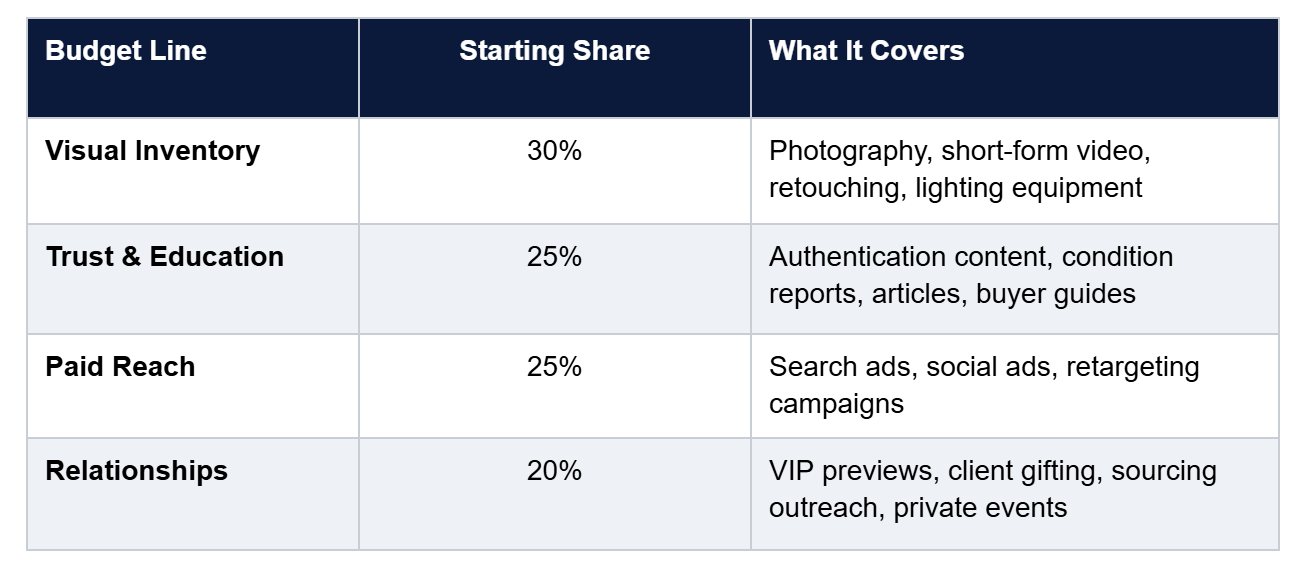
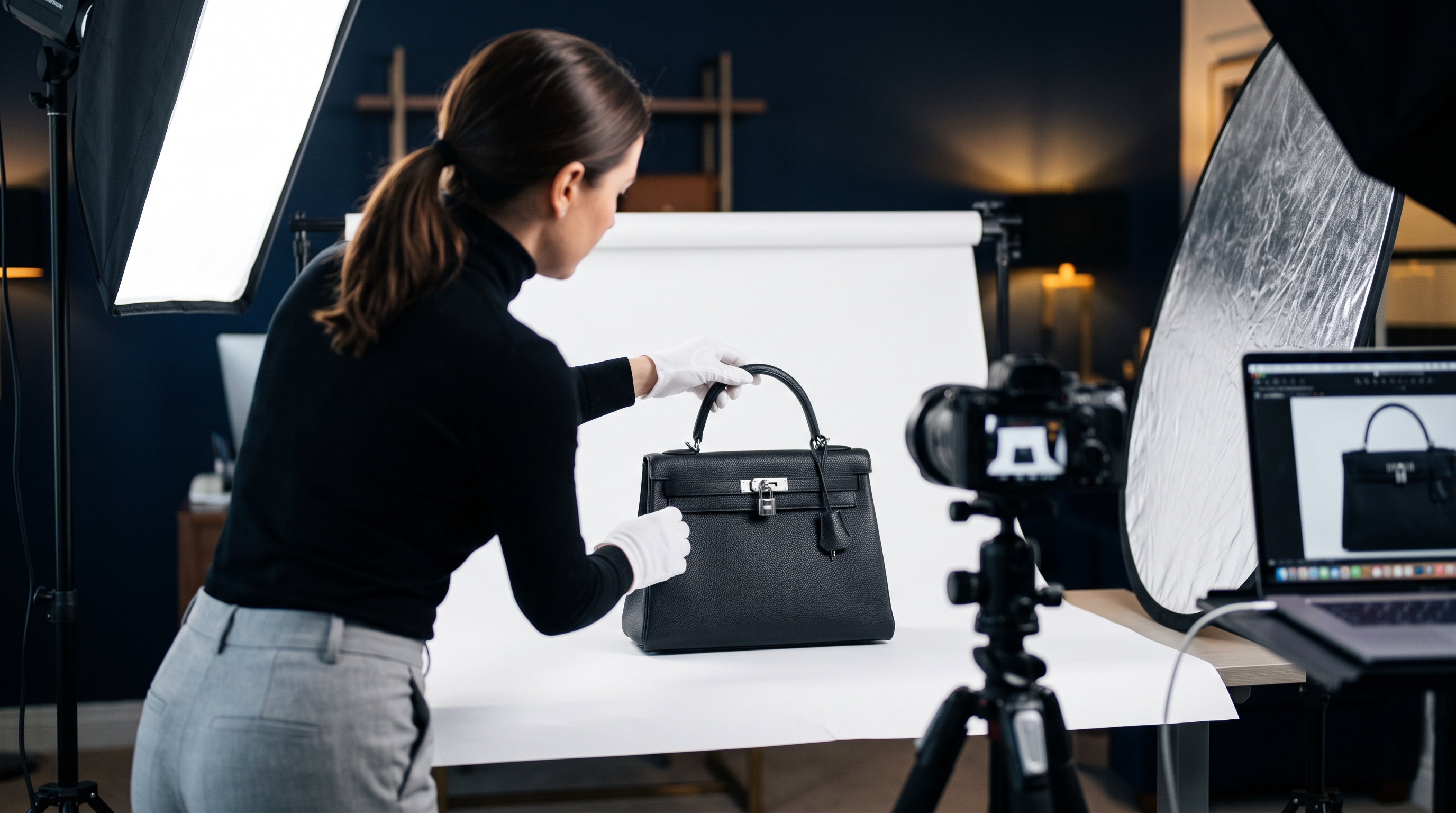
Visual inventory comes first because a luxury bag is sold on detail. Buyers want to see stitching, hardware engravings, corner wear, and interior stamps before they ever message you. Poor photography makes even a pristine piece look questionable.
Trust and education is where luxury dealers separate themselves from anonymous listings. Content that explains how to read a date code, what "excellent condition" actually means, or why hardware color matters positions you as an expert rather than just a seller.
"In this business, the buyer's first question is never the price. It's 'Can I trust you?' Every dollar you spend answering that question before they ask it is a dollar well spent." — Avi-Meir Zaslavsky, founder of 999Precious
Paid reach amplifies what already works. It should push your strongest content and hero pieces, not compensate for weak listings.
Relationships covers the people who generate the most value: repeat clients and reliable sellers. A dealer who markets only to buyers eventually runs out of inventory worth marketing.
Step Three: Build in Two Layers, Fixed and Flexible
A rigid budget breaks the moment a rare piece walks through the door. A loose budget disappears without a trace. The solution is to split your monthly number into two layers.
The fixed layer, around 70 percent, covers commitments that run every month: photography, content production, baseline ad campaigns, and client communication. These are the activities that build consistency.
The flexible layer, around 30 percent, stays in reserve. Use it when a high-demand piece arrives and deserves its own campaign, when seasonal gifting demand rises toward the end of the year, or when a test channel shows early promise. If the month passes without a strong opportunity, roll the reserve forward rather than spending it for the sake of spending.
Step Four: Run the Month on a Weekly Rhythm
A budget only works if it is attached to a schedule. Many successful dealers organize their marketing month into four repeating weeks.
- Week one: review and plan. Look at last month's numbers, decide which pieces to feature, and assign budget to each.
- Week two: produce. Shoot photography and video, write condition reports, and prepare educational content.
- Week three: promote. Launch paid campaigns around featured pieces and publish your strongest content.
- Week four: nurture and report. Reach out to repeat clients, follow up on inquiries, contact sellers, and record results.
"Consistency is what the luxury buyer reads as stability. When a dealer posts for two weeks and then disappears for a month, clients notice. A steady rhythm tells them you'll still be here when they need you." — Avi-Meir Zaslavsky, founder of 999Precious
Step Five: Measure What Actually Moves Bags
Follower counts and likes feel good, but they do not pay for inventory. Track the numbers that connect marketing to revenue.
- Cost per qualified inquiry: how much you spend to get one serious buyer asking about a specific piece.
- Inquiry-to-sale rate: what share of those conversations turn into transactions.
- Average days in inventory: whether marketing is helping pieces move faster.
- Repeat client share: how much revenue comes from buyers who have purchased before.
- Return on ad spend: revenue generated for every dollar spent on paid campaigns.
Give each channel a fair test, typically two to three months, before judging it. If a channel consistently fails to produce qualified inquiries, move its budget to the lines that do.
The Mistakes That Quietly Drain a Bag Dealer's Budget
Even a well-planned budget can leak. These are the patterns that cost dealers the most.
Using discounts as marketing. Markdowns can move a piece, but they also teach clients to wait. In the luxury segment, price cuts can undermine the perception of value you have worked hard to build.
Chasing reach instead of relevance. A viral video seen by thousands of people who will never buy a luxury bag is less valuable than a modest post seen by fifty serious collectors.
Spending everything in peak season. When the entire budget lands during the busiest months, the slower months go dark, and buyers forget you.
Forgetting the sourcing side. Your marketing should speak to sellers as clearly as it speaks to buyers. The dealer with the best inventory usually wins.
"Half of this business is buying well. If your marketing only talks to people who want to buy, you're missing the people who decide what you'll have to sell next month." — Avi-Meir Zaslavsky, founder of 999Precious

The Takeaway: Treat the Budget Like Inventory
The strongest dealers manage their marketing the same way they manage their stock. They know what they put in, they track how long it takes to return, and they cut what doesn't perform.
Start with a percentage your margins can support. Split it into visual inventory, trust and education, paid reach, and relationships. Keep a flexible reserve for opportunities that can't be planned. Run the month on a steady rhythm, measure the numbers that connect to sales, and adjust every thirty days.
A monthly marketing budget will not sell a single bag on its own. What it does is make sure that every piece in your inventory is seen by the right buyer, presented with the credibility it deserves, and supported by a business that clients recognize as reliable. In a market built on trust, that consistency becomes one of the most valuable assets a dealer can own.